Test Article
Upon completion of the course and exams, you will be able to use the title MNU Certified Nutritionist and be eligible to apply for our bespoke insurance policy.
Frequently Asked Questions
Will I be able to practise as a nutritionist at the end of the course?
Upon completion of the course and exams, you will be able to use the title MNU Certified Nutritionist and be eligible to apply for our bespoke insurance policy.
This will allow you to work as a nutritionist in-person and online with clients globally. To find out more about our bespoke insurance policy, you can read: Can I have an overview of the insurance policy?
In many countries, lack of regulation means anyone can practise freely as a nutritionist. This is where being part of MNU and using the title MNU Certified Nutritionist will set you apart; as a collective trademark, only our graduates can use the title.
In some countries such as South Africa and some states, for example Quebec (CAN) and Texas (USA), nutritionist is protected, which may limit your use of the title. Instead, you may wish to refer to yourself as an MNU Certified Nutrition Coach or Consultant, which are often used interchangeably with nutritionist.
As national regulations frequently change, we recommend checking if the title is protected in your country. This is typically available on your Government website or easily found with a quick Google search.
For example, if you reside in the USA, please check out the State Regulation of Nutrition Practice.
What services can I offer after I graduate?
Being an MNU graduate not only sets you apart in terms of increasing your employability, it is also the best possible way to start and/or develop your journey as a self-employed nutritionist with your own nutrition consultancy or coaching business.
Here is just a small sample of the types of services our graduates are offering as MNU Certified Nutritionists:
- In-person Nutrition Consulting (including, but not limited to: 1-2-1 Consultations, Food Diary Analysis and Dietary Assessment, Goal-Specific Personalised Nutrition Interventions, Meal Planning)
- 1-2-1 Online Nutrition Coaching
- Group Weight Loss Clinics
- Online Group Nutrition Coaching
- Educational Courses for Clients
- In-person/Online Seminars for the Corporate Sector
- In-person/Online Presentations for Sport Clubs/Teams
- Practical Workshops and Consulting for Athletes
- Menu Planning and Dietary Analysis for Restaurants, Canteens, Schools etc.
- Contributions to News Articles and Magazines
- Providing Media Interviews and Expert Commentary on Radio and TV
- Individual Body Composition Assessments (service add-on with the Full with Honours course pathway)
Hands on, tailored support to
help you build your business

3 Intensive Days
Hands-on, face to face coaching & education days
Ongoing Support
6 Months of support and accountability
Coaching Calls
Monthly calls to problem solve as your business develops
My client retention rate sits at 98% and I now have a waiting list. I would not be in this situation without MNU.

Will I be able to practise as a nutritionist at the end of the course?
Upon completion of the course and exams, you will be able to use the title MNU Certified Nutritionist and be eligible to apply for our bespoke insurance policy.
This will allow you to work as a nutritionist in-person and online with clients globally. To find out more about our bespoke insurance policy, you can read: Can I have an overview of the insurance policy?
In many countries, lack of regulation means anyone can practise freely as a nutritionist. This is where being part of MNU and using the title MNU Certified Nutritionist will set you apart; as a collective trademark, only our graduates can use the title.
In some countries such as South Africa and some states, for example Quebec (CAN) and Texas (USA), nutritionist is protected, which may limit your use of the title. Instead, you may wish to refer to yourself as an MNU Certified Nutrition Coach or Consultant, which are often used interchangeably with nutritionist.
As national regulations frequently change, we recommend checking if the title is protected in your country. This is typically available on your Government website or easily found with a quick Google search.
For example, if you reside in the USA, please check out the State Regulation of Nutrition Practice.
What services can I offer after I graduate?
Being an MNU graduate not only sets you apart in terms of increasing your employability, it is also the best possible way to start and/or develop your journey as a self-employed nutritionist with your own nutrition consultancy or coaching business.
Here is just a small sample of the types of services our graduates are offering as MNU Certified Nutritionists:
- In-person Nutrition Consulting (including, but not limited to: 1-2-1 Consultations, Food Diary Analysis and Dietary Assessment, Goal-Specific Personalised Nutrition Interventions, Meal Planning)
- 1-2-1 Online Nutrition Coaching
- Group Weight Loss Clinics
- Online Group Nutrition Coaching
- Educational Courses for Clients
- In-person/Online Seminars for the Corporate Sector
- In-person/Online Presentations for Sport Clubs/Teams
- Practical Workshops and Consulting for Athletes
- Menu Planning and Dietary Analysis for Restaurants, Canteens, Schools etc.
- Contributions to News Articles and Magazines
- Providing Media Interviews and Expert Commentary on Radio and TV
- Individual Body Composition Assessments (service add-on with the Full with Honours course pathway)
What does it mean to be a Chartered Nutritionist?
I imagine this is the question on most peoples’ mind. Essentially, a Royal Charter, allows an organisation to to “define its objectives, constitution and [gives it] powers to govern its own affairs.”
The most common question I’ve heard arising in many professionals’ is “Do I need to be a Chartered Nutritionist to work in the industry?” and the very simply answer is, no. It’s important to understand that this is very different from a license to practice e.g. a Medical License.
Consider the fact that some Accountants choose to be chartered, and others don’t. Or that only 17% of practising barristers choose to be members of the Criminal Bar Association – it does not change their ability to practice at all.
Despite it being a relatively meaningless title, it sadden’s me that the Association for Nutrition (AfN) wants to move from it’s current usage of the protected title of ‘Registered Nutritionists’ to the new term of ‘Chartered Nutritionists’. The activities (or non-activities) of the AfN have long concerned me and others and led to me revoking my membership with them as a Registered Nutritionist. Therefore, when I saw they had applied for this Charter it felt like the right thing to do to challenge it even if it cost me several thousands of pound in legal fees.
I raised concerns that the AfN’s own ‘sanction list’ published in September 2018 stated that no registrant currently had any sanctions applied to their registration & no sanction has been applied by the AfN to any registrant in over a year. Indeed, there seemed to be no publicly available evidence of any investigation carried out by the AfN at any point or of it ever having issued any warning to a registrant where a sanction on the Register was not deemed appropriate.
[Since raising these concerns with the government… this list has seemingly disappeared… I feel a bit like an investigative journalist writing that.]
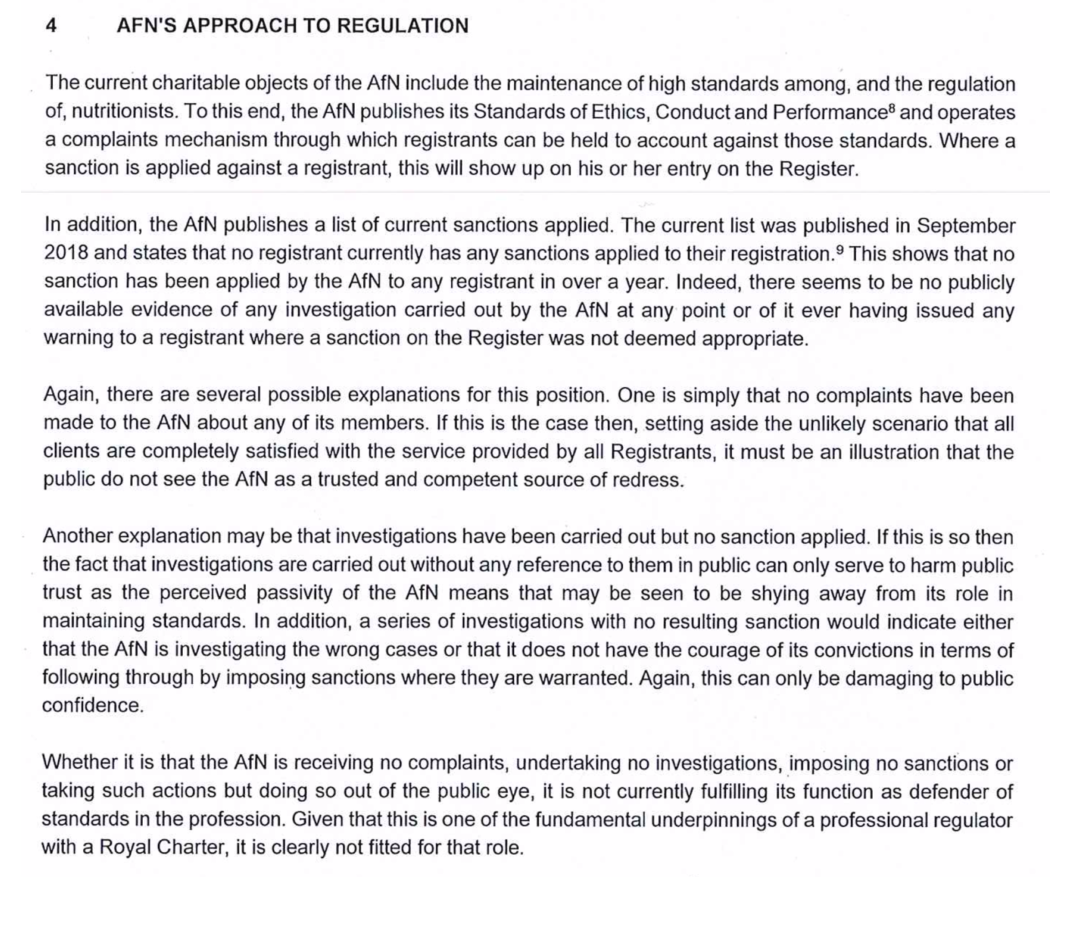
I personally know first-hand that there have been occasions whereby a nutritionist registered with the AfN has been officially complained about by other registered nutritionists and dietitians because they were giving dangerous advice and the AfN barely paid it lip service.
If you click the thumbnail, I am choosing to publish Section 4 “The AfN’s approach to regulation” in its entirety because I think it encapsulates just how ill fitted the AfN are as a regulator of the industry.
The goal of challenging the AfN’s application was never to stop the Charter going ahead but to limit its coverage.
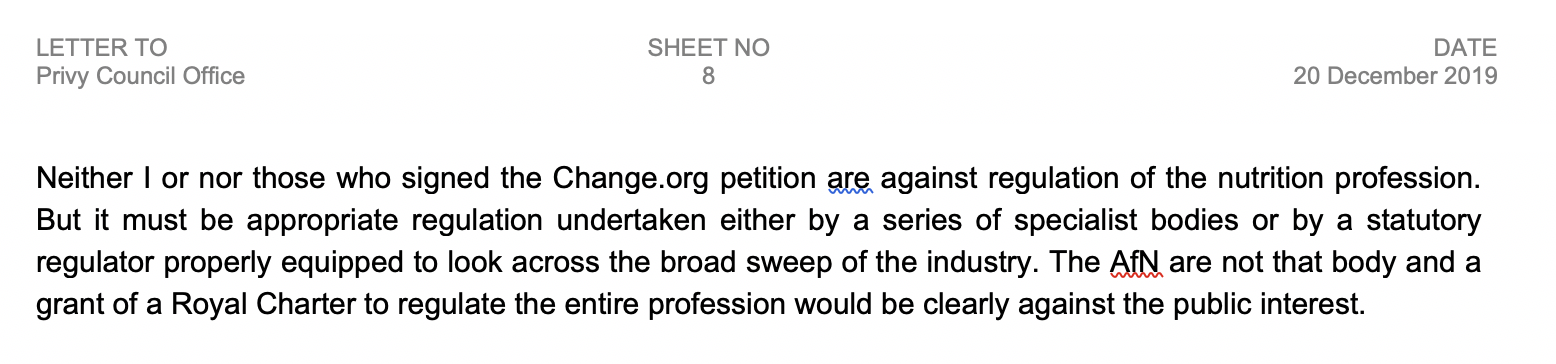
This was my closing statement: